


We implement
B2B platforms
We build B2B platforms for wholesale purchasing. We help trading and manufacturing companies through their digital transformation.





















































This is how we help
We implement B2B platforms that take your business to the next level

Technology consulting
You know B2B e-Commerce is the right path, but don’t know where to start? In our workshops, we’ll help you carry out a successful digital transformation of your business!

B2B platform migration
Is your SaaS subscription eating into your margins? Is technical debt piling up? We’ll move your B2B store to open source, without disrupting your business.

Wholesale platform implementation
We design and implement advanced B2B e-Commerce platforms for companies in wholesale, distribution and multichannel sales.

Project recovery
Taking over struggling B2B implementations is our daily bread. We know the most common causes of problems and how to fix them.

Feature expansion
Does your B2B store need to grow? You can count on our recommendations and on us to put them into practice.

Integrations
We build complex integrations with your company’s software and with other sales channels.


Why does WK Dzik have a B2B platform on Magento?
In 2026, we implemented a wholesale ordering platform for retail chains, food service outlets and fitness clubs.
Dzik chose Magento Open Source after a ready-made subscription B2B platform failed to meet its business requirements.
The apparent speed and lower cost of a ready-made platform are tempting. But where a complex purchasing process, stable ERP integrations and industry-specific requirements come into play, Magento is the better fit.
They reached higher with us
Check out our most exciting B2B implementations




Your new B2B platform
Selected features we can implement for you:
-
 Price Per Customer
-
 Backorders
-
 Business customer verification
-
 Sales representative dashboard
-
 Free gifts in cart
-
 Products for selected customers
-
 Showroom integration
-
 Product quantity calculator
-
 Deal of the day
-
 Product labels
-
 PunchOut catalog
-
 Multistore: one admin, many stores
-
 Customer panel
-
 Shopping lists
-
 Security module
-
 ERP integration
-
 PIM integration
-
 Intelligent search engine
-
 B2B product page
-
 B2B payment methods
-
 Offer builder
-
 Negotiation module
-
 Quick purchases
-
 Multi-warehouse support
-
 B2B customer permission levels
-
 Convenient product listing
-
 Advanced logistics
-
 Substitutes for unavailable products
-
 Advanced price management
-
 Discount levels
-
 Product bundle creation
-
 AI assistant
Benefits of implementing B2B e-Commerce
Your client
They will be able to buy on their own from any device, without involving a salesperson. They will buy exactly what they need and pay the way that suits them best. This is how the current generation does business.
Sales department
Your salespeople will get a powerful sales support tool. They will gain time to look after the clients who need individual attention.
Your business
Let’s face it, you won’t scale your business by constantly adding more people to your sales department. A B2B platform will let you grow and automate your sales. Besides, it’s simply… the 21st century, and your clients expect it.
Marketing department
It can finally spread its wings. Online sales will let it reach a much broader audience, especially if you choose an open B2B platform that is visible in search engine results.



Free consultation
Not ready to work with us yet? We can talk with no commitment. Here’s our time, just for you.
Book a consultation

B2B Platform for the Medical Industry
Magento implementation for Meringer, which has led to exponential sales growth… just like customer satisfaction on the platform.
- outdated design
- incomplete product offering
- slow loading times
- no pricing policy implemented
- complicated purchasing process
- modern design and UX
- full product offering
- lightning-fast speed
- personalized pricing
- customers buy the way they like and need
What Meringer gained from B2B e-Commerce:
faster website
higher sales year over year
orders in 3 weeks


Industries
No industry scares us. In every one, we deliver real value.

Medical
We implemented and keep developing Meringer, the largest online wholesaler of medical supplies in Poland.
learn more
Cosmetics
We implemented a modern B2B platform for Clarena, a professional cosmetics brand.
learn more
Fashion
As part of our long-term partnership with Volcano, we built a platform for wholesale customers alongside the B2C store we had created for the brand earlier.
see the case study
Home decor
For Raw Decor, we rebuilt an advanced e-Commerce store that serves both retail customers and subcontractors.
learn more
Jewelry
We know the jewelry industry inside out, thanks to 5 years of building and developing the online store for Briju 1920.
see the case study
Packaging
We built two B2B packaging platforms from scratch, for Ampak and Poprawa. We know the business requirements of customers in this industry.
see the case study
Bookstores and publishers
We implement and develop B2B/B2C e-Commerce for Edu-Książka and Wydawnictwo Operon. We design features that help our clients’ businesses grow.
see the case study
FMCG and supplements
For WK Dzik, we built a modern B2B platform with a loyalty program, an extended customer panel and ERP integration.
learn more
Workwear and safety
For Elmar BHP, one of the largest manufacturers and distributors of workwear and safety equipment in Poland, we implemented a wholesale platform with PunchOut catalog integration.
Why Satisfly?
We have the skills and the certifications, but that’s not where the secret to our success lies.
-
We’ve done this before
For over 14 years, we have been helping ambitious companies gain a market edge. We know a lot about B2B e-Commerce and won’t hesitate to use that knowledge to unlock your project’s potential. We have profitable B2B stores on our record that have taken our clients’ sales to a higher level.
-
We focus on business
An implementation partner should understand and achieve the client’s business goals. Sounds obvious? Sure. Is it rare? Unfortunately, yes. For us, it’s what decides whether a B2B implementation succeeds.
-
We care about your money
If you’re afraid of wasted budgets and scope creep… we understand. Market practice tells us these are common problems. At Satisfly, we have a remedy: a proven budget control process. You’ll get to know it at our very first meeting.


How do we price a project?
Budget matters. We’ve gathered everything about estimates, pricing and billing in one place, so your decision is simple and risk-free.
Learn moreBudget matters. We’ve gathered everything about estimates, pricing and billing in one place, so your decision is simple and risk-free.
Learn moreB2B e-Commerce ecosystem
See which systems we integrate:
-
ERP
If you sell to business clients, you definitely use an ERP system. Your B2B platform will be fully integrated with it.
-
PunchOut catalog
A PunchOut catalog connects your offer with another company’s e-procurement or ERP system. Corporations and government agencies often require it.
-
WMS
Your warehouse management system will also find its place in your ecosystem. We’ll integrate it with your ERP and B2B platform according to the architecture we plan together during workshops.
-
PIM
Your client needs complete information about every product you offer. We will integrate your B2B platform with Product Information Management software.
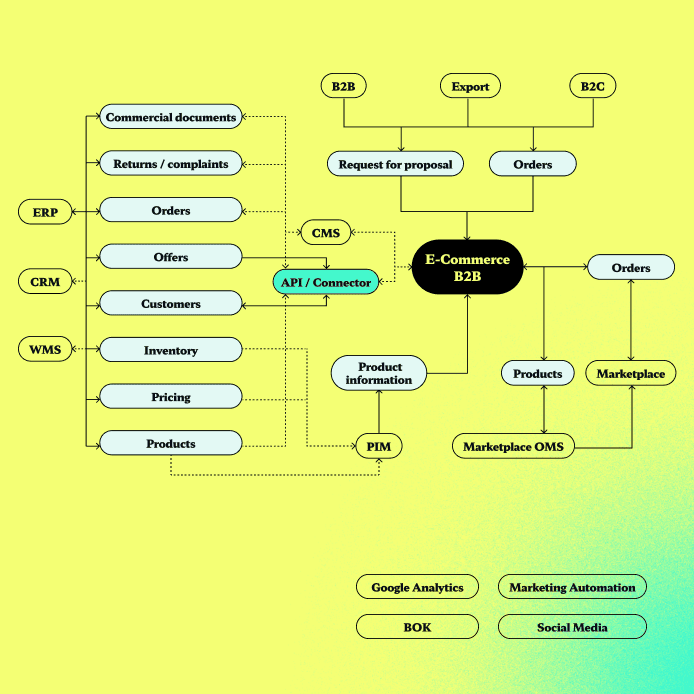
We will integrate your B2B platform with:
We have a broad portfolio of integrations with popular business applications


and many more
B2B Suite
B2B Suite by Satisfly is our own package of Magento 2 modules that adds the features you need to sell to business customers, such as trade credit, EU VAT validation and individual customer price lists.
With the package, we implement B2B platforms much faster and at a lower cost.
B2B Suite by Satisfly is our own package of Magento 2 modules that adds the features you need to sell to business customers, such as trade credit, EU VAT validation and individual customer price lists.
With the package, we implement B2B platforms much faster and at a lower cost.
Technologies
We implement efficient B2B platforms based on the following technologies:

Magento 2 (open source)
A leader among e-Commerce platforms that gives your business scalability, flexibility and the support of a large community. A B2B store on Magento will be fast, functional and ready for years of business growth.
learn more
Prestashop
Open-source software for building online stores, popular in Poland. It offers modules and plugins that add the features needed for selling to business customers.
learn more
Shopify Plus
The top Shopify plan, with features for serving business customers. Choose it if you prefer a subscription-based solution.
learn more
Shopware
A very popular e-Commerce platform in Germany with its own built-in B2B module. With it, we can create an efficient, responsive B2B platform tailored to the needs and habits of your customers.
learn moreYour path to success
B2B e-Commerce implementation plan in 5 steps.

-
First contact and a free consultation
- you talk with our consultant, Marek Kich;
- you discuss the business need the B2B platform should address;
- together, you analyze the current situation in your company with the planned transformation in mind;
- you fill out the brief.
-
Pricing and contract
- you receive a project cost estimate along with a draft of your company’s digital architecture;
- we discuss both together;
- we sign a time and material contract.
-
Pre-implementation analysis
- we run workshops together and go through the features of the B2B platform in detail;
- at the same time, we work on page mockups under the guidance of our UX team;
- the analysis results in a more accurate estimate of the implementation and a clearly defined scope of the MVP, i.e. the first selling version of the store.
-
MVP implementation
- we work on the frontend, backend and integrations;
- along the way, we meet regularly for status updates, daily standups and demos presenting progress;
- you have full control over the budget and the tasks being implemented.
-
Development and maintenance
- the same team that implemented your e-Commerce will look after its development;
- for your peace of mind, we offer SLA packages;
- together, we plan the development of sales, marketing, SEO, technology and automation to ensure a solid return on investment.
We highly recommend working with Satisfly. They’re a team of experts who not only understand e-Commerce but also advise on the best business solutions. The store rollout went smoothly, and the final result met our expectations—we got a fast, modern store equipped with many bespoke features tailored to our needs.
Piotr Kołata, Product Owner @Meringer
Working with Satisfly restored our faith in the agencies currently on the market.
The project didn’t start with code, but with analytical workshops and a thorough review of our processes — and that decided everything that followed. The migration of laneperfumy.pl from PrestaShop to Shopify Plus, together with a custom integrator connecting the store to our ERP system, was carried out in a single night: no rollback, no sales downtime, and not a single critical ticket in the first days after launch. In e-commerce, that’s the best possible recommendation.
Separately, I want to give credit to the people. We were given a stable, experienced team — across project management, front-end, and integration — that understood our business, spoke openly about risks, and delivered what it promised. The way we worked together was collaborative and concrete: a clear division of roles, predictable communication, and decisions made exactly when they needed to be.
Mateusz Anci, CEO @Ambra Lane Perfumy

It was a good choice! I especially appreciate how quickly we got on the same page — a start with no long ramp-up like that is rare. You took the project on in a tricky state and straightened it out — no drama, you simply did what needed to be done. I also particularly value the effective communication and the way you stuck to what we’d agreed on and to the framework of the collaboration.
Krystian Gagoś, Vice President of Growth @Hagi
We appreciated that the Satisfly team truly understood our business perspective. From the very beginning, it was clear they believe that close collaboration between our organizations is the only path to success.
Tomasz Cynar, E-Commerce Manager @Briju

Everything was delivered as it should be – on time and within budget. Minor inconsistencies did appear, but that’s to be expected in any implementation or even in day-to-day operations. To sum it up: 100% quality, 100% cooperation, 100% communication, 100% transparency, 1% bugs (fixed immediately).
Piotr Celej, Product Owner @Merida

I greatly appreciate the fast and flexible contact with the Satisfly team, the well-organized way they work, and their punctuality in delivering tasks. What’s especially important is the partnership-driven approach. We felt that our goals were shared and that our challenges were treated as a priority. As a result, the collaboration runs smoothly, and we have a sense of security and confidence that the growth of our store is in good hands.
Joanna Wegner, Marketing Manager @RawDecor

Satisfly helped us launch a completely new version of our store, which now allows us to grow B2B sales online with confidence. I also appreciate the team’s support with our rebranding and redefining the foundations of the Ampak brand.
Aleksander Hałaszewski, Co-owner @Ampak


Book a consultation
Free, no obligation. Time only for you.

FAQ
Ask and you shall not wander
A B2B e-Commerce platform is an online store for business customers, such as wholesalers, retail chains, salons or installers. The buyer logs in to their company account, sees their own prices, discounts and credit limit, orders larger quantities and pays on invoice terms. The order goes straight to the seller’s ERP system, with no retyping. Customers order on their own at any time, and sales reps and customer service no longer have to enter orders from emails, phone calls and Excel files by hand.
The foundation is purchasing only after logging in. The customer creates a company account and verifies it with their Polish tax ID (NIP). This can be automated by fetching company data from the GUS registry (Company Data from GUS module) and, for EU customers, by validating the VAT number in VIES (EU VAT Validation in VIES module). The second essential feature is individual trading terms: each customer or customer group has its own prices, discounts, payment methods and logistics (Contract Price Lists module). Larger buyers also need company accounts with multiple users and roles (Organizations, Roles and Permissions), trade credit and quick ordering from a list or a file.
The goal is the same, which is selling, but the purchasing process is different. A B2C store has one price for everyone, while a B2B platform shows each customer their own price list and discounts. In B2C, customers pay upfront. In B2B, they often pay on terms, within their trade credit. A B2C account belongs to one person, while a B2B account belongs to a company where several employees have different permissions and larger orders may need approval. B2B orders are also larger and more repetitive, so fast ordering by SKU or from a file matters. Remember, though, that there is always a person on the other side of the screen who knows good UX from everyday shopping and expects the same from your B2B platform.
No. The platform takes over the routine: retyping orders into the ERP and answering questions about prices, availability and delivery status. Sales reps stop being order processors and focus on customer relationships, negotiations and winning new accounts. They can also place orders on the customer’s behalf by logging in to their account, and the customer sees their account manager on the platform (Account Manager and Support Contacts module).
Most often on Magento Open Source. It is an open-source engine with no license fees, where almost any feature can be built, and we deliver typical B2B features with our own Satisfly B2B Suite modules. We recommend Magento when you need individual trading terms, ERP integration and further platform development in the years ahead. For simpler processes, we also implement Shopware with its ready-made B2B package for wholesale and Shopify Plus with its features for business customers. We choose the platform after analyzing your needs. Read more on our Magento B2B page.
Most often with manufacturers and distributors with an annual turnover of roughly PLN 20 million or more and over 5,000 SKUs in their catalog. Turnover is not the main criterion, though. What matters more is how closely the platform has to fit your sales processes and how it will develop in the years ahead. At this scale, the platform must handle a large catalog, individual trading terms and integrations with the systems your company uses.
We have implemented B2B platforms in FMCG (wholesale platform for WK Dzik), medical supplies (Meringer), cosmetics and hairdressing (Clarena, Activeshop), packaging (Ampak), books (Edu-Książka) and workwear and safety equipment (Elmar), among others. Price lists, logistics and ordering look different in each of them, so we always design the platform around the processes of the specific company.
We tailor every implementation to the sales processes of the specific company. Our projects include, among other things:
- handling large product catalogs and PIM integration,
- integrations with ERP, warehouse systems and order management tools,
- individual price lists, tiered prices and product bundles,
- company accounts with multiple users, roles and order approvals,
- assigning customers to sales reps, sales rep dashboards and reports on customer sales and spending,
- wholesale orders, recurring orders and orders imported from CSV or Excel files,
- trade credit and deferred payments,
- backorders, product substitutes and stock availability.
We deliver typical B2B features with ready-made Satisfly B2B Suite modules and build the rest around your processes.
Yes. ERP integration is a standard part of our B2B implementations. We sync products, stock levels, individual prices, credit limits, orders, invoices and customer data. We have ready-made integrations with Comarch ERP XL, Comarch ERP Altum, Wapro, VENDO ERP, Gardens, Streamsoft, Teneum, Microsoft Dynamics 365, enova365, Subiekt, Symfonia and SAP, among others. For other systems, we check their capabilities during the pre-implementation analysis and design a custom integration.
Besides ERP, we integrate B2B platforms with PIM systems (Akeneo, Ergonode), WMS, CRM and order management systems such as Baselinker, as well as with payments, carriers and marketing tools. For corporate buyers, we also implement a PunchOut catalog, which lets them buy from your offer directly from their procurement system. In this setup, each piece of data has a single source of truth, so nobody has to correct it by hand in several systems. If you use a less common system, we will check the integration options during the analysis.
There are usually four. The first is ERP integration: we confirm its scope in the analysis, test risky touchpoints with a short proof of concept and design integrations with automatic retries and an error queue, so a temporary ERP outage does not lose data or stop sales. The second is too broad a scope at launch: we start with an MVP containing the key features and develop the platform in stages. The third is poor product data: with a large catalog, we organize it in a PIM system. The fourth is low adoption by customers: if ordering online is slower than calling a sales rep, customers will not change their habits. That is why we design fast ordering paths, such as ordering from a CSV file or a shopping list, and our design team works on the UX.
No. You can launch the platform for a selected group of customers first, collect their feedback and gradually add more. We take the same approach to scope: we always recommend starting with an MVP and adding further features in stages. Registering new customers can also be automated: companies create their own accounts and invite their colleagues (Company Users module), and data from GUS and VIES is filled in automatically.
No. Besides technical implementations, we provide strategic consulting and design technology and sales architecture. We help you choose the platform and systems, plan integrations and set up your B2B sales processes before development starts. Our UX and design team also works on our projects. Our lead consultant is Marek Kich, CEO of Satisfly, who hosts the Polish-language podcast Sztuka E-Commerce on YouTube.
We have been in business for 14 years and have more than 120 successful implementations behind us, and our clients’ stores have generated a total of PLN 1.3 billion in revenue. We are rated 4.9/5 on Clutch, and on the technology side, we are a certified Hyvä and ScandiPWA partner. The B2B platforms we build deliver measurable results: Meringer increased sales by 230% year over year, and WK Dzik received 2,317 orders in six months. We work with open code, the copyright to the code passes to you, and you can use the pre-implementation analysis document with us or with another vendor.
A B2B platform implementation on Magento usually costs more than PLN 150,000. A large B2B platform with ERP integration, a PunchOut catalog, PIM and a logistics module most often costs PLN 250,000–500,000. These ranges include ERP integration, and with Magento Open Source you do not pay for a platform license. Costs are driven most by integrations with other systems, changes to the purchasing process and features that no ready-made module covers. We give a binding quote after the pre-implementation analysis. Read more on our Pricing page and in our article on Magento costs.
A typical B2B platform implementation takes 3 to 9 months, depending on the number of integrations and the scope of features. Projects based on ready-made modules take less time, while extensive integrations with ERP, CRM or logistics systems require several stages of work and additional testing. We always recommend starting with an MVP, so sales start sooner. We launched the B2B platform MVP for Edu-Książka in 3 months, for Clarena in 4 and for Ampak in 5.
Most B2B platforms need the same features, so we don’t write them from scratch in every project. We have 15 modules of our own in the Satisfly B2B Suite package, including Contract Price Lists, Order Approvals, Trade Credit, Shopping Lists and Offers and Team Budgets. We install them and configure them for your processes, so your budget and the team’s time go to the features that set your business apart. The modules run on Magento Open Source and Mage-OS from version 2.4.7, with Hyvä and Luma themes.

